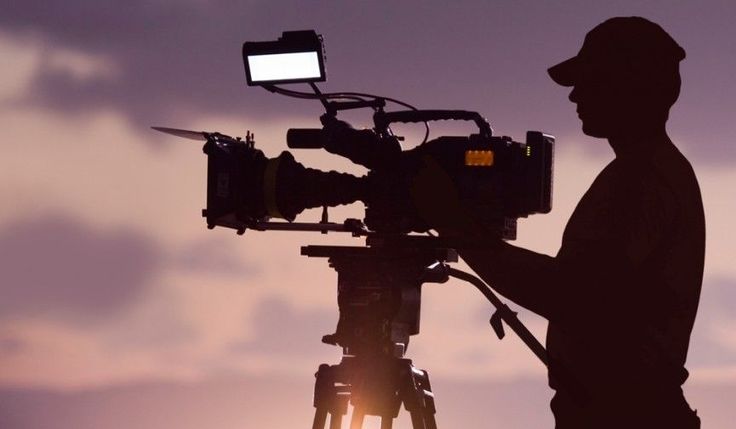
Imagine you have paid 1500 rupees to watch a movie in the theatre & they end up ruining your experience with bad sound quality; exactly why you were unable to feel the movie and just watched it. Sound is a really important part of a movie. A footstep on gravel, a door creaking shut, the rustling of a jacket as a character turns around these tiny details are what pull us out of our seats and into the world on screen. They build the emotional zone a film lives in, long before we consciously notice they’re even there. Take the sound away, and even the most beautifully shot scene feels flat, distant, unconvincing.
But a secret process is hidden behind these sound effects that bring life into the movie,e and that is – Foley Art or Foley sound effects. Very oftenit’ss rebuilt from scratch in a specialised studio by someone standing in the dark, watching the scene, and physically recreating every sound by hand. That craft is called Foley art, and it’s one of the most underrated skills in sound design in filmmaking.
The birth of Foley sound effects happened in the hands of Jack Donovan Foley, an American sound artist at Universal Studios.
The Sound You Never Knew You Were Hearing
Overall, sound design and Foley are not just about realism; they’re about building emotional resonance throughout the film. Foley is the technique of creating and recording everyday sound effects:s footsteps, clothing movement, object handling, physical impacts in sync with the picture, performed live by a Foley artist watching the scene on a screen in front of them. It happened because, while transitioning from Pantomime and Silent movies into a full-talkie movie, sound design became a primary part of these films and although then it was a new process, even after so many years it is still used, because while the actual shoot of a movie the focus is more on Dilogue delivery more than the background sound effects. Hence, these Foley sound effects tell the story through sound and set the mood of the whole scene.
Why Doesn’t On-Set Audio Just… Work?
This question is raised by almost every beginner who walks the path of filmmaking, or those who are new to learningFoleyy art.
The answer is that the sounds captured during the actual shoot are only usable for dialogue, but when it comes to supplementary sounds from the raw footage, instead of uplifting the mood, they create unwanted disturbances. Also, there are technical limitations in giving maximum attention to detail; the ambient voice and crew movement voice can become a hurdle. In such a situation, Foley becomes a bridge to fill these sound gaps.
The fundamental reason why the on-set raw voice is always compromised is:
- Camera and crew noise. Even a quiet set has camera motors, crew movement, and equipment hum bleeding into the microphone.
- Microphone placement. Production sound is recorded to capture clean dialogue; the mic is positioned for voice, not footsteps or fabric movement, so those sounds often come through thin, distant, or missing entirely.
- Multiple takes, multiple inconsistencies. A scene cut together from several takes will have subtly different ambient sound in each one, creating jarring inconsistency if left as-is.
- Silent props. A “sword” on set might be rubber. A “wooden table” might be a lightweight prop. What you see and what would realistically sound are often two different objects entirely.
Behind the Screen: A Peek Inside the Foley Stage
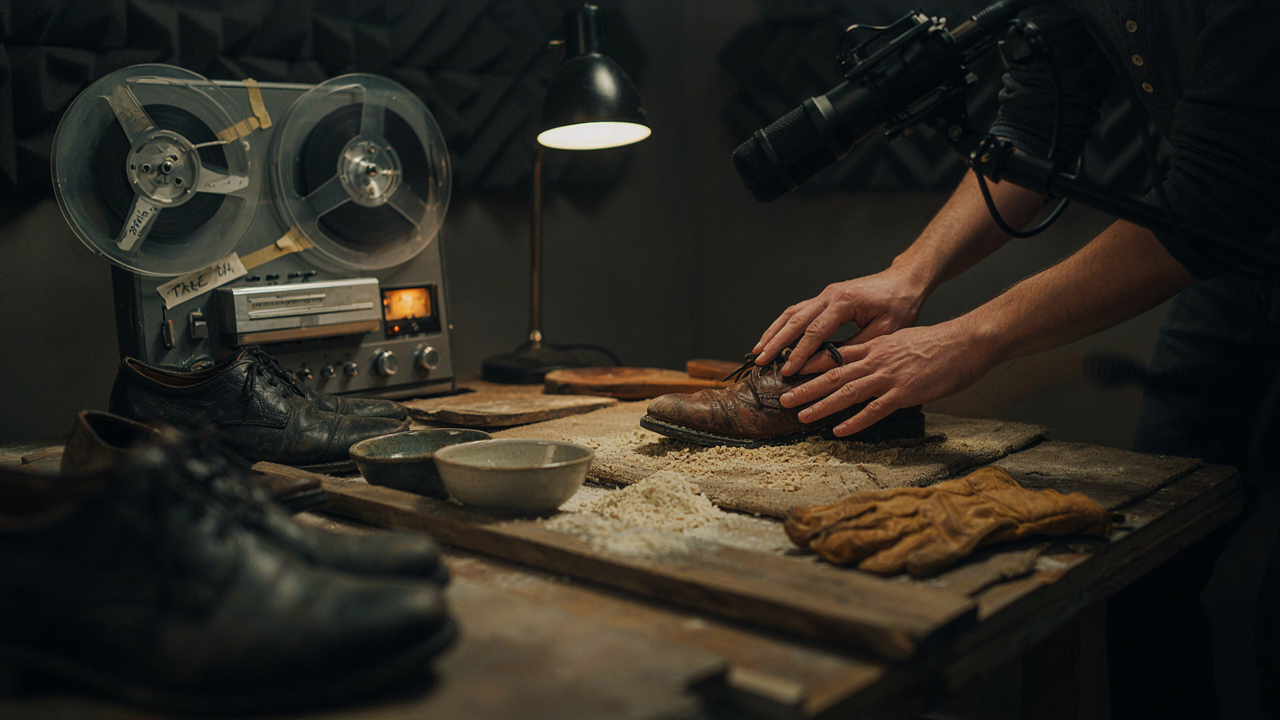
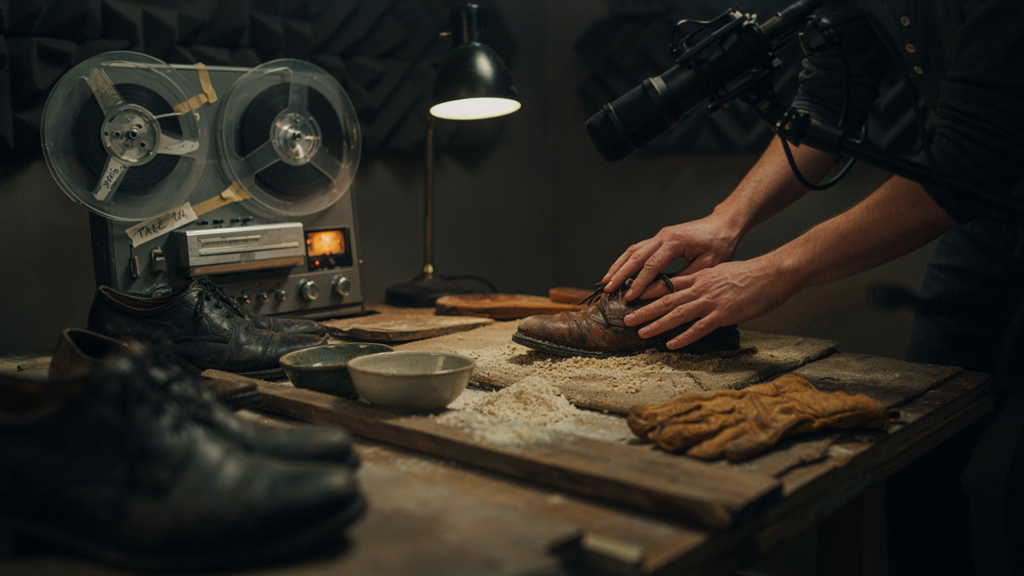
A foley artist can actually create magic via unimaginable tools that they can use to make these various sound effects. Foley studio is a strange, wonderful place part sound stage, part prop room, part performance space. Foley artists work with Foley pits: sunken sections of floor filled with different surfaces gravel, sand, concrete, wood, grass so footsteps can be performed on exactly the right texture for a scene.
Foley artists build an entire library of physical tricks to recreate sounds that would be impossible or impractical to capture any other way:
- Crushing celery to imitate breaking bones
- Snapping stalks of lettuce or cabbage for punches and body impacts
- Shaking a leather glove or wallet for the sound of bird wings flapping
- Coconut shells for horse hooves, a trick almost as old as Foley itself
- Cornstarch squeezed in a leather pouch for the sound of footsteps in snow.
Now this is just a small snippet and doesn’t sound like too much, but properly syncing it with the picture and motions is quite a task. A skilled Foley artist studies the scene closely, watches an actor’s exact movement and weight, and then performs the sound live, in real time. At e-Drishyam Film School, students exploring sound design courses in Mumbai & Thane are made familiar with the whole Sound profiling pipeline. They discover how their Foley recording blends into larger post-production workflows and how to collaborate effectively with other roles for maximum synergy and impact.
The Three Pillars of Foley Sound Effects
Foley work is generally organised into three core categories:
- Footsteps – arguably the most significant and technically demanding category. Every character’s walk has a distinct weight, pace, and surface, and Foley artists often physically walk in sync with the actor on screen, matching footwear, surface, and pace.
- Movement- the sound of clothing rustling, body shifts, and general physical motion that fills in the space around dialogue and action, giving a scene a sense of physical presence.
- Specifics– particular sound effects tied to a straightforward on-screen action: a glass being set down, a punch landing, a door slamming, a gun being holstered. These are performed and recorded separately, then layered precisely against the picture.
Together, these three layers are what make a scene feel physically real, grounded, textured, and alive rather than sitting on top of the picture like an afterthought.
Building These Skills the Right Way
Foley and sound design aren’t skills you pick up by reading about them; they’re built through hands-on practice, real Foley pits, real microphones, and real scenes to sync against. This is exactly the gap that structured, practical training is meant to close.
At e-Drishyam Film School, students exploring sound design courses in Mumbai & Thane get exactly that kind of hands-on training, working directly with Foley techniques, sound editing tools, and real film scenes, guided by faculty with genuine industry experience. Rather than treating sound as an afterthought layered on at the end of production, students learn to think about sound design as a filmmaking discipline in its own right one that shapes how an audience feels a story, not just how they see it.