Introduction: The New Era of Filmmaking Has Already Begun
Filmmaking has always evolved alongside technology. From silent films to talkies, from analogue cameras to digital cinema, every technological leap has reshaped how stories are told. Today, we are witnessing another major transformation: AI in filmmaking.
Artificial Intelligence is no longer a futuristic concept reserved for tech labs or Hollywood giants. It has entered film schools, editing rooms, production studios, and even mobile phones. For students and aspiring filmmakers, this shift isn’t something to fear; it’s something to learn, master, and leverage.
At e-Drishyam Film School, students are encouraged to understand not just traditional filmmaking techniques but also how modern tools, especially AI-powered ones, are redefining storytelling, efficiency, and creativity.
This blog explores how AI is changing filmmaking, with a special focus on AI video editing tools every student should know, and why learning them early can give you a powerful edge in the industry.
What Does AI in Filmmaking Really Mean?
Before diving into tools, it’s important to understand what AI in filmmaking actually involves.
Artificial Intelligence in filmmaking refers to software and systems that can:
- Learn from data (footage, scripts, audio, visuals)
- Automate repetitive tasks
- Assist creative decision-making
- Predict outcomes and improve efficiency
Unlike traditional software that follows fixed rules, AI adapts, improves, and evolves based on usage and input.
In filmmaking, AI is now used across:
- Scriptwriting and story development
- Pre-production planning
- Cinematography and shot analysis
- Editing, colour grading, and sound design
- Marketing, trailers, and audience prediction
For students at e-Drishyam Film School, this means the filmmaker’s skill set is expanding to combine art, storytelling, and intelligent technology.
Why Film Students Must Learn AI Tools Early
The film industry is highly competitive. Knowing only conventional techniques is no longer enough.
Here’s why AI knowledge is becoming essential for students:
1. Faster Workflows, More Creativity
AI handles time-consuming technical tasks, allowing filmmakers to focus more on storytelling and direction.
2. Industry Demand Is Shifting
Production houses, studios, and agencies increasingly prefer professionals who understand AI video editing and smart workflows.
3. Independent Filmmaking Becomes More Powerful
With AI, even low-budget creators can achieve high-quality output, levelling the playing field.
4. Career Versatility
Understanding AI opens doors beyond filmmaking to content creation, advertising, OTT platforms, gaming, and digital media.
At e-Drishyam Film School, this future-focused mindset prepares students not just for their first job, but for long-term industry relevance.
AI in Pre-Production: Smarter Planning, Better Stories
AI-Assisted Scriptwriting and Story Analysis
AI tools can now analyse scripts to:
- Predict audience engagement
- Suggest structural improvements
- Identify pacing issues
- Flag weak character arcs
While AI doesn’t replace writers, it acts as a creative assistant, offering insights that help writers refine their scripts.
For film students, this is especially useful during:
- Short film development
- Student projects
- Script workshops
Learning to collaborate with AI tools at e-Drishyam Film School helps students sharpen their storytelling instincts.
AI for Storyboarding and Visual Planning
AI-powered visual tools can:
- Convert scripts into rough storyboards
- Suggest camera angles
- Generate visual references
This speeds up pre-production and helps directors and cinematographers align creatively before stepping onto set.
AI in Production: On-Set Intelligence
Smart Camera Assistance
Modern cameras and AI-driven software can:
- Track subjects automatically
- Maintain focus and exposure
- Analyse composition in real time
This doesn’t replace the cinematographer, but it enhances precision, especially in dynamic shooting environments.
Students trained at e-Drishyam Film School learn how to use technology without losing creative control, which is a crucial balance.
AI for Lighting and Scene Optimisation
AI systems can analyse:
- Light intensity
- Shadows
- Color temperature
They then recommend optimal lighting setups based on the scene’s mood. This is particularly useful for students who are still mastering lighting theory.
AI Video Editing: The Biggest Game Changer
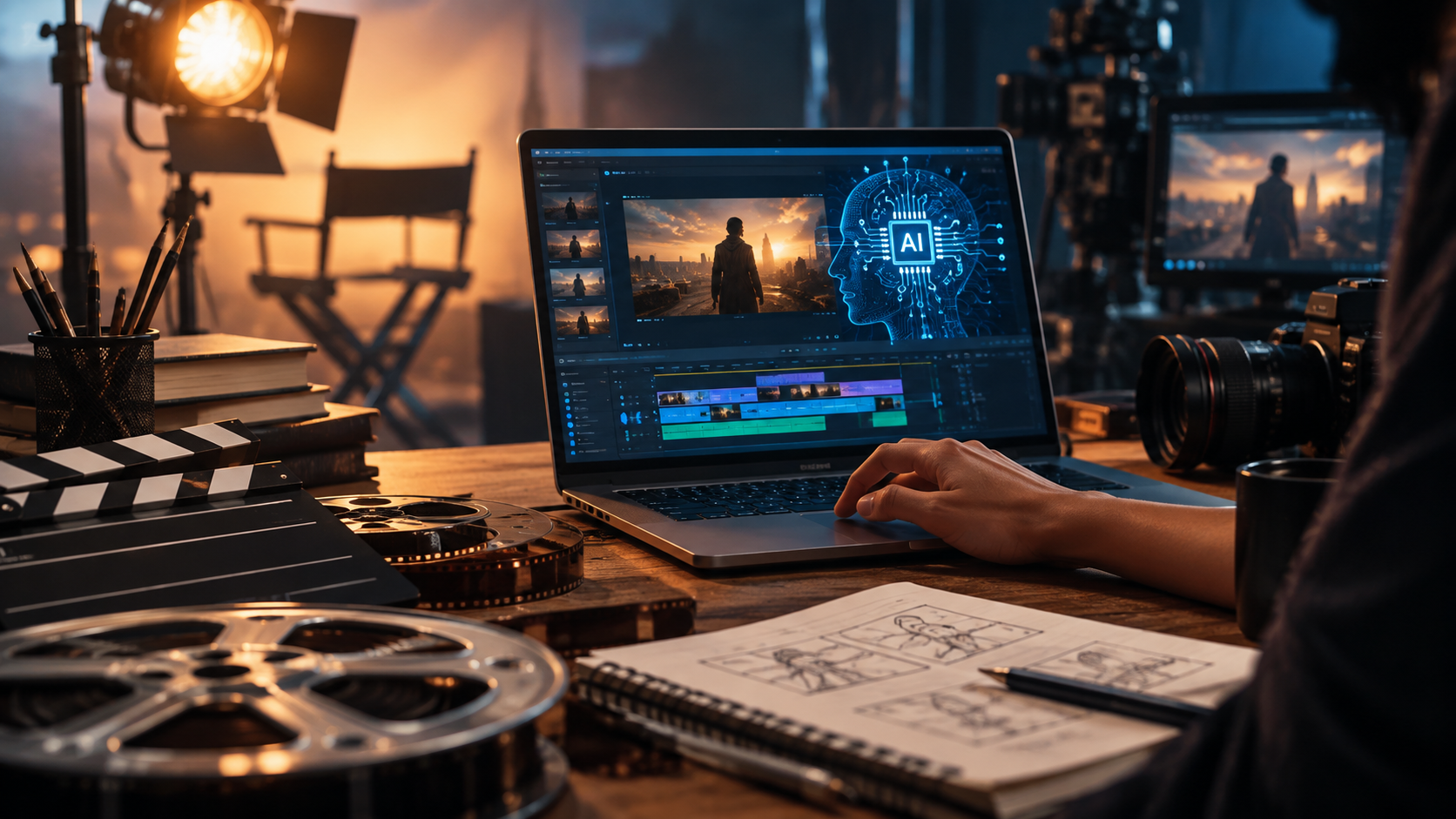
Among all applications, AI video editing has had the most visible and immediate impact.
Let’s break down how it’s transforming post-production.
How AI Is Revolutionising Video Editing
1. Automated Rough Cuts
AI can analyse footage and automatically:
- Detect the best takes
- Remove unusable clips
- Create rough timelines
- This saves editors hours, sometimes days, of manual sorting.
For film students, this means:
- Faster project completion
- More time for creative refinement
- Less burnout during deadlines
At e-Drishyam Film School, students are encouraged to use AI as a starting point, not the final decision-maker.
2. Intelligent Scene Detection
AI tools can recognise:
- Scene changes
- Shot types
- Facial expressions
- Emotional intensity
This allows editors to organise footage smarter and edit more intuitively.
3. AI-Powered Colour Grading
Colour grading used to require years of experience. AI has changed that.
AI tools can:
- Match colours across shots
- Apply cinematic LUTs intelligently
- Balance skin tones automatically
Students still need to understand colour theory, but AI dramatically reduces the learning curve.
4. Sound Editing and Audio Cleanup
AI now plays a massive role in sound design:
- Noise removal
- Dialogue enhancement
- Audio leveling
- Automatic subtitles and captions
This is especially valuable for student filmmakers working in uncontrolled environments.
AI Tools Every Film Student Should Know
Here’s a category-wise breakdown of AI tools that aspiring filmmakers should familiarise themselves with during their training at e-Drishyam Film School.
AI Video Editing Tools
These tools use AI to speed up editing workflows, automate tasks, and improve output quality.
Key capabilities include:
- Smart cuts
- Auto-reframing for different platforms
- Facial recognition-based editing
- Music and beat syncing
Learning these tools helps students adapt to modern editing demands across films, reels, ads, and OTT content.
AI Tools for VFX and Visual Effects
AI is transforming VFX by:
- Automating rotoscoping
- Enhancing backgrounds
- Generating realistic effects faster
This reduces technical barriers and allows students to experiment creatively without massive budgets.
AI for Motion Graphics and Animation
AI-powered animation tools can:
- Animate still images
- Generate motion paths
- Assist in character animation
For students interested in animation and hybrid filmmaking, this opens exciting new creative possibilities.
AI in Marketing and Film Distribution
Filmmaking doesn’t end after post-production. AI now plays a huge role in film promotion and audience reach.
AI for Trailers and Teasers
AI can analyse a full film and:
- Identify the most engaging moments
- Create trailer drafts
- Optimise pacing for social platforms
Students at e-Drishyam Film School learn that understanding AI isn’t just about making films; it’s about getting them seen.
AI for Audience Prediction
Some AI systems analyse:
- Genre trends
- Viewer behavior
- Platform data
They help predict which type of content will perform well on OTT platforms, YouTube, or social media.
This insight is invaluable for filmmakers planning careers in digital cinema.
Does AI Replace Filmmakers? The Truth Students Should Know
One of the biggest fears around AI in filmmaking is job replacement.
Let’s be clear:
AI does not replace filmmakers; it replaces inefficiency.
AI cannot:
- Feel emotions
- Understand cultural nuance
- Create original human experiences
- Replace artistic intuition
What it does is:
- Reduce repetitive work
- Enhance productivity
- Support creative decisions
At e-Drishyam Film School, students are taught to see AI as a collaborator, not a competitor.
How e-Drishyam Film School Prepares Students for an AI-Driven Film Industry
What sets e-Drishyam Film School apart is its future-focused approach to film education.
Students are trained to:
- Understand traditional filmmaking foundations
- Learn modern AI-powered tools
- Adapt to evolving industry demands
- Build portfolios that reflect current workflows
Instead of resisting technology, the curriculum encourages students to blend creativity with innovation, the hallmark of successful modern filmmakers.
Skills Film Students Should Develop Alongside AI
AI tools are powerful, but they work best when paired with strong fundamentals.
Students should focus on:
- Storytelling and narrative structure
- Visual composition
- Editing rhythm
- Emotional pacing
- Sound design basics
At e-Drishyam Film School, AI is introduced on top of these foundations, not as a shortcut.
The Future of AI in Filmmaking
Looking ahead, AI will likely:
- Become more intuitive
- Integrate deeply into creative workflows
- Offer real-time creative suggestions
- Enable personalised storytelling experiences
For students entering the industry now, this is the most exciting time to learn filmmaking.
Those trained in both cinematic craft and AI video editing will lead the next generation of cinema.
Final Thoughts: Learn the Tools, Lead the Change
AI is not a trend, it’s a transformation.
For aspiring filmmakers, the question is no longer “Should I learn AI?”
It’s “How well can I use AI to enhance my creativity?”
By understanding AI in filmmaking, mastering AI video-editing tools, and studying at a future-ready institution like e-Drishyam Film School, students position themselves for long-term success in a rapidly evolving industry.
The future of cinema belongs to storytellers who can combine human emotion with intelligent technology, and that journey starts with learning today.