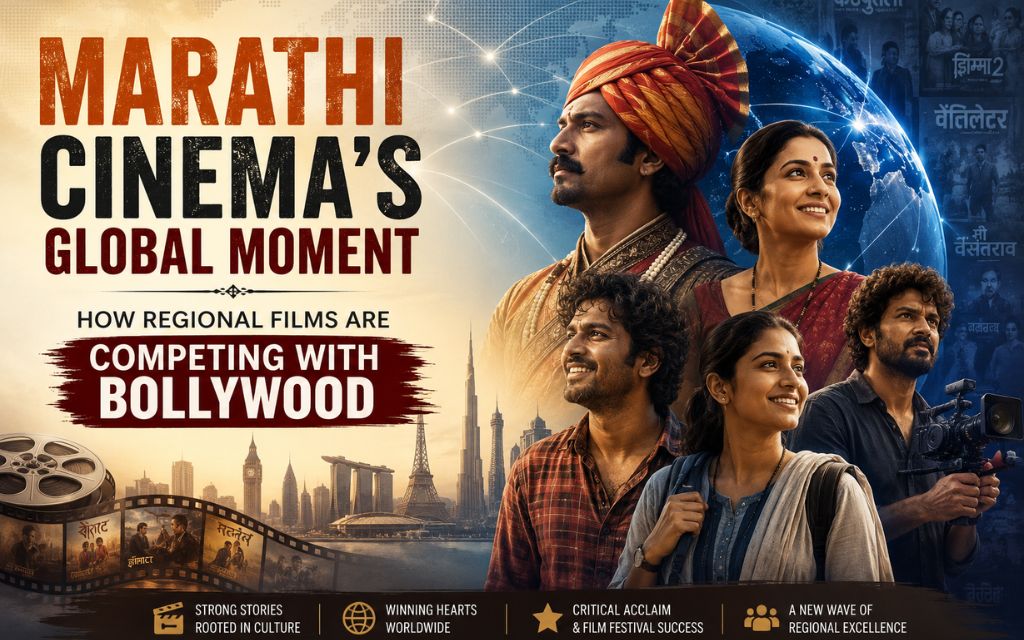
The films that are quietly rewriting India’s cinema map weren’t made on massive budgets or backed by studios. They were made with conviction — and that’s exactly why they’re winning.
Picture this: a Marathi film with no A-list Bollywood star, no item number, no marketing blitz — and yet it runs to packed houses, sweeps national awards, and gets discussed in the same breath as global arthouse cinema. It sounds unlikely. And yet, it has happened repeatedly in the last decade.
What’s unfolding in the Marathi film industry isn’t a lucky streak. It’s a structural shift — a change in how Marathi filmmakers tell stories, find audiences, and define what Indian cinema can be. And if you’re someone who loves cinema, wants to make films, or is simply paying attention, this moment deserves your full focus.
A Tradition That Never Lost Its Voice
Before we talk about where Marathi cinema is going, it helps to remember where it came from. Maharashtra isn’t new to filmmaking. Dadasaheb Phalke — the man widely credited as the father of Indian cinema — made his films here. The Marathi film industry has been producing work since the earliest days of Indian cinema, building a tradition rooted in social realism, literary adaptation, and performance.
What’s different now is the scale of ambition. Marathi films are no longer content to speak only to a regional audience. They’re building one that reaches across India and beyond.

What Makes Marathi Cinema Different — and Why It’s Working
Here’s where things get interesting. The commercial Hindi film industry — Bollywood — operates on a certain grammar: bankable stars, franchise thinking, familiar story structures, massive production and marketing spend. It’s a machine that works, but it has limits. What Marathi cinema has done is find the gaps.
Story-first filmmaking
Films like Sairat, Fandry, Court, and Natsamrat succeeded because the story came first. Not the cast. Not the budget. Not the release date. The script was the foundation — and audiences felt it. What most people don’t realise is that this isn’t accidental. Marathi filmmakers have, by necessity, had to rely on the strength of their narratives because they didn’t always have the resources to paper over weak storytelling with spectacle.
That discipline has now become a competitive advantage.
Social courage on screen
Marathi cinema has consistently taken on subjects that mainstream Bollywood tends to avoid — caste, drought, agrarian distress, gender violence, custodial rights. Films like Fandry and Nagraj Manjule’s body of work brought Dalit narratives to the centre of Indian screen culture in a way that was genuinely groundbreaking. These weren’t niche films. They became cultural events.
“When the story is honest and the craft is real, language is never a barrier. Audiences find the film — not the other way around.”
New directors, new voices
The Marathi film industry has produced a generation of directors — Nagraj Manjule, Chaitanya Tamhane, Umesh Kulkarni, Ravi Jadhav — who are not waiting for permission from anyone. Tamhane’s Court won the National Award and competed at Venice. That’s not a regional filmmaker making good. That’s a filmmaker operating at the highest global register, who happens to be working in Marathi.

Marathi Cinema vs Bollywood: Competition or Coexistence?
It’s tempting to frame Marathi cinema vs Bollywood as a rivalry. It’s more complicated — and more interesting — than that.
The relationship is one of creative tension and mutual influence. Bollywood has borrowed from Marathi storytelling; Marathi cinema has sometimes been seduced by Bollywood’s scale. The more useful question isn’t which is better — it’s what each does best, and why.
Bollywood at its best delivers spectacle, emotion at scale, and cultural universality. Marathi cinema at its best delivers precision — a specific truth told so honestly that it becomes universal. The global film community increasingly recognises the latter.
What Marathi cinema does differently
Prioritises script development over star casting
Draws from strong Marathi literary and theatrical traditions
Produces films that travel well on international festival circuits
Operates on tighter budgets — which forces creative discipline
Builds directors as auteurs with distinct, recognisable voices
The OTT Effect: How Streaming Changed Everything
If there was one inflection point that expanded Marathi cinema’s reach beyond Maharashtra, it was the rise of OTT platforms. Netflix, Amazon Prime, Disney+ Hotstar and others didn’t just distribute Marathi films — they introduced them to audiences in Tamil Nadu, Punjab, the UK, and the US who had no prior connection to the language.
Sairat — arguably the biggest Marathi crossover film of the last decade — found an audience far beyond its theatrical run precisely because streaming brought it to people who would never have walked into a Marathi cinema hall. When Dhadak, the Hindi remake, arrived, many viewers had already seen the original and preferred it. That’s a remarkable cultural moment for regional cinema in India.
The lesson here for filmmakers is important: OTT has flattened the hierarchy of language. A compelling Marathi film now has the same shelf life and reach as a Hindi one. The question is no longer about access. It’s about quality.
Regional Cinema in India: A Broader Revolution
Marathi cinema doesn’t exist in isolation. It’s part of a much larger shift in how Indian audiences consume stories. Tamil, Telugu, Malayalam, and Kannada cinema have all had extraordinary global moments in recent years. RRR, KGF, and the Malayalam industry’s reputation for writing — particularly in the thriller genre — have collectively redrawn the map of Indian filmmaking.
What this tells the next generation of filmmakers is something powerful: the audience is not loyal to a language. They are loyal to a great story, told well. Regional cinema in India has proven this beyond any doubt.
For aspiring filmmakers, particularly those based in Mumbai and Maharashtra, this is not background information. It’s a strategic insight. The infrastructure, the tradition, the audience attention — all of it is right here. The opportunity to make meaningful Marathi cinema, or to bring regional filmmaking sensibilities to larger productions, has never been more viable.

What This Means If You Want to Make Films
Understanding the Marathi film industry isn’t just cultural literacy — it’s professional preparation. If you’re training as a filmmaker, director, or screenwriter in Mumbai, studying what’s worked in Marathi cinema gives you a masterclass in lean, story-driven production. You learn to ask: what is the irreducible core of this story? What does it cost to tell it honestly?
In our experience, students who engage deeply with regional cinema — who watch Court, Fandry, and Sairat with the same rigour they apply to Scorsese or Nolan — come away with sharper instincts. They understand that filmmaking isn’t about resources. It’s about choices.
A good filmmaking course in Mumbai will give you the technical grounding — direction, cinematography, sound design, editing — but the creative sensibility has to come from watching and understanding what great films actually do. Marathi cinema, right now, is one of the best classrooms available.
Looking Ahead: Marathi Cinema’s Next Chapter
The conversation around Marathi cinema is no longer about whether it can compete globally. It already has. The question is what comes next — and who will make those films.
The industry needs trained, thoughtful filmmakers who understand both the tradition they’re inheriting and the tools available to them today. The craft of storytelling hasn’t changed. The platforms, the audiences, and the expectations have. The filmmaker who can navigate all three — who has real technical training, genuine creative vision, and an understanding of where Indian regional cinema is headed — is the one who will define this next chapter.
That filmmaker could be you.
Ready to tell your story?
At e-Drishyam Film School in Thane, we train filmmakers who understand their craft — technically and creatively. Explore our filmmaking courses in Mumbai and book a free demo lecture.
Explore filmmaking courses